Monday, September 1, 2025

Stylophone GEN X-2 Expands on its Predecessor

 Oops! I did it again. I bought a piece of musical gear that I wanted but really didn't need. This time it was the new Stylophone GEN X-2 portable analog synthesizer, which replaces the apparently discontinued GEN X-1.


Why didn't I need it? For a couple of reasons: I already have the Stylophone GEN X-1, which is mostly identical in both form and function to the GEN X-2. And because the most significant new features of the GEN X-2 are its CV (Control Voltage) capabilities.

If you aren't familiar with CV, it is a simple system that allows synthesizers and related analog electronic components to control each other remotely. For example, pressing a key on a CV keyboard can send two voltage signals to a modular synthesizer. The pitch CV signal instructs the synth to play a specific pitch or note, and the gate CV signal controls when to activate or deactivate the sound. A third CV signal can also be used to adjust the value of a corresponding knob, such as modulation depth or filter cutoff.

CV control is 1960s technology, but it still works, and it's still pretty cool. CV is essential for communication and interaction between most of the current Eurorack synthesizer modules. And that's why I didn't really need the GEN X-2. I've been trying to downsize my life over the last year or two, getting rid of things that no longer felt essential. In the past, I definitely suffered from Gear Acquisition Syndrome, buying far more stuff than I ever learned to use properly. So last year, I sold the vast majority of my Eurorack equipment. Now, I only own a few standalone synth items that have CV connectivity. And really, I don't even need those because I am not a professional gigging musician or recording artist. I am mostly a hobbyist, and I play my synths to amuse myself occasionally. So, I don't need an elaborate setup like I once had.

I bring this up because I want to emphasize that if you already have the GEN X-1 and love it, but don't have other CV-capable synthesizer products, then the additional features of the GEN X-2 will be of little to no benefit. However, if you do want to get into Eurorack, then the GEN X-2 can definitely be part of your introduction to that whole world. Just keep in mind that the CV features of the GEN X-2 require some other piece of compatible gear. Unlike the Stylophone GEN R-8, the GEN X-2 is not designed for self-patching* between components within a single instrument. So, you will need a sequencer, a semi-modular synthesizer, a keyboard controller, or a Eurorack system to take advantage of the GEN X-2. When you do have it patched up with another compatible product, you can play the GEN X-2 keyboard with the stylus to control the sound of the other gear. Or you can do the reverse, and use the other product to play the sound of the GEN X-2.

I did some experiments to see how well the CV connectivity performed. (This required a few 3.5mm TS mono audio patch cables, not included.) As a controller, the GEN X-2 definitely can be used to play other synths, but I found the same challenges associated with any stylus instrument. I had to look at the metal keyboard surface as I played to make sure I was hitting the right notes, and I had to make a conscious effort to firmly press down on the stylus for a good electrical connection. I much preferred using the GEN X-2 as the sound source controlled by other gear. It performed well with the Korg SQ-1 sequencer. And I could control it effectively with the Stylophone GEN R-8 with both the touch keyboard and the on-board sequencer.

Results were less satisfactory with a Behringer Swing controller keyboard. At least with my particular Swing and GEN X-2, there seemed to be a mismatch with the CV Gate voltage. The sound was not stopping when I stopped pressing a key. To fix this, I had to route the CV Gate signal through an attenuator module on my Behringer Neutron semi-modular synthesizer and adjust the corresponding knob until everything seemed to work correctly. I have not been able to find the voltage rating of the Swing's CV Gate output, so I don't know exactly what is causing the problem when connecting directly to the GEN X-2, but the attenuator did fix it. (FYI - There is more than one standard voltage for CV gate signals. So this is always a risk if you don't know the specs of your instruments before you buy them.)

I also had an expected problem when using a Moog Werkstatt-01 as a keyboard controller for the GEN X-2. In this case, it was the pitch CV signal from the Moog that was an issue. For some unexplained reason, the Werkstatt was not designed to output the more-or-less standard 1 volt per octave pitch CV signal. There is a note about this in the Werkstatt owner's manual that says an attenuator is required to get it to play pitches correctly with other gear. So, once again, I had to route through the attenuator on my Neutron to get the GEN X-2 to play an in-tune chromatic scale. (Gate CV, by the way, worked just fine when patched directly.)

As you can imagine, patching three portable or standalone synths to get something musical out of them can be rather cumbersome and not very portable. So, I see the CV capability of the GEN X-2 as an introduction to CV control and a tool for experimentation, but probably not something that will serve as your primary controller or sound generator in a large Eurorack setup or as part of your traveling gear for performing on-stage.

Still, the Stylophone GEN X-2 is a fun, but limited, analog synthesizer that you can throw into a purse or backpack with a pair of headphones to compose, jam, or just make funny noises almost anywhere. If you don't already have a GEN X-1, I think it's worthy of your consideration.


QUICK TIP

* One self-patch that does seem to work is to connect a cable between the GEN X-2 pitch out jack and the filter in jack. The filter cutoff frequency will shift up or down as you play different pitches across the keyboard.

Monday, August 4, 2025

New Gen-R-8 Patch Sheet for 2025

Back in March 2020, I shared my photo-realistic patch sheet for Dubreq's Stylophone Gen-R-8 synthesizer. Based on reader feedback, I re-worked it a few months later, so that it could be printed with less printer ink or toner. Then Markus Schroeder of NoiseBau came up with his own, superior design. At the time, I shared a link to his patch sheet.

Fast-forward to 2025: Markus has made improvements to his design and invited me to share it here. This current patch sheet is definitely the one you should be using. It has space for two patches per page. You can print it and mark the patch settings with a pen, then store the sheets in a binder. Take a digital scan of your patch for electronic storage.

Or you can do what I plan to do. I am going to load the .pdf file into my Kindle Scribe e-reader device. It allows me to write on the document with a stylus.

Here's what a single patch might look like:

(I just made random markings as an example. I haven't attempted to use these settings as a real patch on the Gen-R-8 yet.)


To make your own patches on this new-and-improved patch sheet, download a copy by clicking here.


Monday, January 20, 2025

Dubreq gets busy: New (x2), Newer, Newest

Dubreq, Ltd., the company behind the Stylophone brand, has been super busy of late. In recent weeks they have shipped two products that were announced about a year ago. They have put out another new product with very little advanced notice. And this week they have announced the sound shaper of things to come. Here's a quick overview:

NEW 

Stylophone theremin
In late 2024, the UK-based company started delivering the long-awaited Stylophone Theremin that it first teased a year ago at Winter NAMM Show 2024. The entry-level noisemaker combines a pitch-only theremin with a simple slider-pot-controlled synthesizer. The theremin half of the instrument works fairly well, considering its low price. It makes for a nice intro to the instrument category for music makers who want to experiment with the antenna-controlled device but don't want to invest hundreds of dollars more for a more serious, professional-quality, instrument. The synthesizer half of the Stylophone Theremin works much like an Electro-theremin or Tannerin, and is somewhat reminiscent of an Ondes Martenot. The slider is easier to play with some degree of accuracy than the theremin, and the sound is more stable and pure. However, the two sides of the instrument can modulate each other if noise is your thing. I purchased a Stylophone Theremin and I have enjoyed messing around with it, but it will probably not be my go-to theremin when I want to record or perform live. (Just like I wouldn't use a basic model Stylophone keyboard in place of Hammond organ.) The slider synth, though, could come in handy for more precision playing.

I recently featured an interview with Jake Rothman on my Theremin 30 podcast. Jake designed the prototype units of the Stylophone Theremin.


ALSO NEW

Stylophone DS-2 Analog Drone Synthesizer
Also, in recent days, Dubreq began shipping the DS-2 Analog Drone Synth, its first compact portable modular synthesizer. Like the Stylophone Theremin, the DS-2 was announced in conjunction with the Winter NAMM show last year. The DS-2 is packed with oscillators, sub-oscillators, LFOs, and other analog controls for a rich, keyboardless drones. I haven't purchased the DS-2, but I look forward to hearing what creative musicians will do with it.


NEWER


At the end of 2024, Dubreq released the Stylosette Keys keyboard with little fanfare. Unlike its flagship product line, the Stylosette Keys instrument doesn't employ a stylus. The touch-sensitive keyboard is built into a circuit board designed to resemble an old-school compact cassette audio tape. (Remember those?) It shares some similarities with the Open Music Labs Mixtape Alpha synthesizer (2012) and the MicroKits Synth-A-Sette (2023). Like both, the Stylosette Keys fits neatly in an audio cassette case and uses touch surfaces instead of physical keys. And like the Synth-A-Sette, it includes jumper cables that can be connected to conductive objects, making them substitutes for the touch keys on the built-in keyboard. Built-in features include variable-speed vibrato, octave shift, adjustable delay, volume control, a tiny speaker, and a headphone jack.

Stylophone Stylosette (front view)Stylophone Stylosette (back view)


NEWEST


Finally, in time for Winter NAMM Show 2025, Dubreq has announced the second entry in its compact portable modular series, the DF-8 Analog Dynamic Multifilter. In the same form factor as the DS-2 synth, this new unit provides multiple envelopes, filters, and noise sources. Also like the DS-2, it can be used as a portable tabletop device or installed in a Eurorack environment. Dubreq is building a waiting list that does not require a deposit. The delivery date is unknown, but I expect it to be in the second half of this year, based on how long it took for the DS-2 to reach the market.
Dubreq DF-8 analog multifilter


Friday, January 12, 2024

E.T. Drone Home!

You can get yourself lost in space with the alien sounds of the Stylophone CPM DS-2, just unveiled by Dubreq at the 2024 Winter NAMM Show in Anaheim, California. 

With two-oscillators, two sub-oscillators, an LFO, reverb, delay, a mixer, and 12 modular patch points, this synth has plenty of sonic tools in a compact footprint.

Powered by AA batteries, it work as a standalone compact portable modular (CPM) instrument. Or you can patch it into a Eurorack system. I would love to plug it into my Stylophone Gen R-8 synthesizer to create some thicker keyboard-controlled sounds or to power the DS-2 with the arpeggiator of the Gen R-8.

The expected list price is $259 USD. You can pre-order now, with no money due until they are ready to ship at https://stylophone.com/ds2-pre-order/


Check out the teaser video here:


Monday, January 8, 2024

New Stylophone Theremin is also a Tannerin!

 The creative minds at Dubreq have created a new version of something old. The Stylophone Theremin is now available for pre-order from the Stylophone website


Dubreq Stylophone Theremin

image courtesy of Dubreq, Ltd.

What excites me most about the instrument is that there are two ways to control the pitch. The telescopic antenna allows for space control like a traditional theremin. There is also a slider with pitch markings reminiscent of the Electro-Theremin or the Tannerin. It was this type of controller actually used in the Beach Boys tune "Good Vibrations," although it is often mistaken for a theremin. 


The promotional photos show that the volume envelope can be controlled by a push-button. It reminds me a bit of the expression control keys of an Ondes Martenot. 

I can't wait to get my hands off of one of these cool new instruments. List price is expected to be about $110 USD. Details are at https://stylophone.com/theremin-pre-order/

------

Update, December 2024 - The Stylophone Theremin is now available. I interview the electronic prototype designer, Jake Rothman, in my December 2024 Theremin 30 podcast.

Friday, August 11, 2023

Stylophone: We got the BEAT!

 New product alert! Dubreq Ltd announced their newest product today: the Stylophone BEAT. I haven't had an opportunity to play one yet, but it looks like a really fun and much-needed step up from the classic Stylophone Beatbox.


According to the email notice I received, the Stylophone BEAT will feature 4 drum sounds, 4 bass sounds, adjustable tempo, loop recording, a transposition control, storage for more than one pattern, and the ability to change the pattern length on the fly. There's also an audio out jack for headphones or to send the sound to an external mixer, PA system, or recording gear. The overall size and styling is very much in keeping with the current versions of the original Stylophone keyboard instruments.

The pre-order price is $39.95 USD, 29.95 GBP, or 34.95 Euros. You can get more info and reserve an instrument at StylophoneBeat.com.


MicroKits goes retro-future with the Synth-A-Sette

MicroKits makes a fun little theremin electronics kit for kids that I recently featured on the Theremin 30 podcast. After that interview, MicroKits founder and designer David Levi let me try out the company's second product, the Synth-A-Sette. As of this writing, the first batch of Synth-A-Settes are already sold out, but more will available soon.

This cool little keyboard shares some characteristics with the Stylophone, so I thought I should feature it here.


The Synth-A-Sette is a monophonic keyboard instrument built with a form factor nearly identical to an audio cassette tape. (Remember those?) In fact, it is packaged inside a plastic cassette box. The non-moving keyboard is part of the circuit board. There is one full octave of touch-pad keys, but an octave jump button raises all the pitches to give you a second octave. 


The range of the instrument can be transposed with a tuning wheel in one corner. It has about two octaves of adjustability, so you can set up the instrument to play in just about any major or minor key (or most of those weird modes you learn about in music theory class.)  This is particularly handy when you want to jam with other musicians and keep your Synth-A-Sette in tune with their instruments.

Another rotary control adjusts the volume. One switch turns the power on and off. Another toggles a vibrato effect. There's also a headphone jack for private listening or to connect to external audio gear.


It's cool to see all the tiny electronic components on the bottom. Some of them are labeled so you can know what they do. A pair of AAA power the instrument for portable play. There's also a USB C jack for AC power. To save on batteries, there is also an automatic shut-off feature.


The little obround holes along the edges of the keys are meant for use with alligator clip cables. A set of cables is included in the package. With them, you can connect the eight "white" keys (think of a piano here) to everyday household objects. For example -- eight bananas, or whatever fruit you have handy.  Then with another cable connected between the grounding hole and your own body (don't pinch yourself with an alligator clip!) you can touch each banana in sequence to complete the circuit and play a melody. Metal objects will work best, of course, but experiment with other objects or eight of your best friends to see what else will make beautiful music.


And how does this instrument sound? Well, its analog tone generating circuit sounds similar to an electronic organ or a classic Stylophone. There is only one patch available, but running the headphone output signal through some guitar effects pedals could create some wild new timbres!

You can learn more about the MicroKits Synth-A-Sette, hear some sound samples, and get on the waiting list for the next batch of instruments at https://microkits.net/products/synth-a-sette.


Friday, December 3, 2021

A best-case scenario for the Stylophone Gen X-1

 I hadn't played my Gen X-1 for quite some time. When I took it off the shelf recently, I found that it wasn't working as well as it should. The keyboard had become dirty just from being exposed to household air and dust. I cleaned the metal keyboard and stylus to get it working again. But I decided it would be best to not openly display it on the shelves where I keep my Stylophone collection if I still want to be able to play it for years to come.


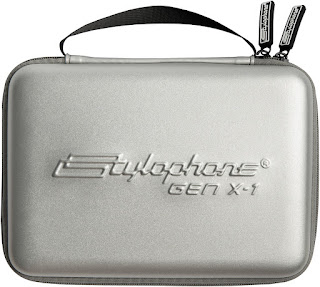
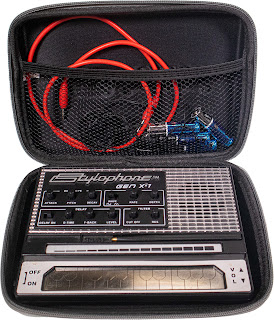
Fortunately, dubreq now offers a carrying case for Gen X-1.  I am not sure when it was launched, but the case is now available on Amazon, so I ordered one and just got it a couple of days ago. 


Like the case for the S-1, this case is made from a semi-rigid foam material. It's embossed with the Stylophone logo, has a zipper, and a nylon fabric handle. It's made to perfectly fit the Gen X-1 and has enough extra space to store some cables and spare batteries.

It's a simple but perfect product for storing a Gen X-1 or transporting it to a gig. If you have a Gen X-1, check out this case. It would make a cool Christmas gift for yourself or any Stylophone enthusiast in your life.

Sunday, October 3, 2021

Ground Control to Major Cool! Dubreq releases David Bowie themed Stylophone.

A number of well-known musicians have used Stylophones in their recordings: Kraftwerk, Little Boots, Orbital, Erasure, Raconteurs, They Might Be Giants, and others. But the biggest star to use the instrument has to be the late David Bowie. The Starman's 1969 breakthrough single "Space Oddity" was the first popular recording to feature the Stylophone. The handheld instrument also appears in a couple of tracks on his 2002 album Heathen, and David has played Stylophone on stage. David also appeared in advertisements for the instrument.

David Bowie Stylophone graphic

Dubreq, the company that makes Stylophones, now has a special, limited-edition model of their flagship pocket synthesizer to commemorate the career of David Bowie and his association with the Stylophone. This is their second artist tie-in I know of that affected the appearance of the instrument (as opposed to just the box and booklet like they did with Rolf Harris and Bill Ramsey.) The company released a fun, black-and-copper Stylophone with Raconteurs stickers and packaging back in 2008. It was only sold at Raconteurs concerts and through the band's website, and it has become quite a collector's item.

The Bowie Stylophone is a variant of their current "original analog sound" S1, sporting a white cabinet, with a chrome-look grille featuring a large, 3-dimensional, official BOWIE logo, licensed from the David Bowie Archive. The sounds, switches, and jacks are where you would expect, and do what you would expect: power on/off, tremolo on/off, 3-position octave shift, headphone jack, tuning knob, and volume wheel. The one exception is that this limited-edition model runs on batteries only. There is no mini USB jack to power the instrument from an AC wall outlet, as was added to the previous S1 release.

Bowie Stylophone


The box features the BOWIE logo and a vintage photo of David playing an original model Stylophone. It is the same photo that was featured in Stylophone ads at the time. The 24-page instruction booklet features a short article about the history of the Stylophone and highlights of David Bowie's music career from 1969 to 2016, with lots of color images of picture sleeves, posters, and David in the studio and on stage. A quote from longtime Bowie producer and collaborator David Visconti recounts how David was ecstatic to be among the first artists to receive a complimentary Stylophone. That is a detail I did not know. There are also play-along tabs for melodies from "Space Oddity," "Suffragette City," "Golden Years," "Modern Love," "I'm Afraid of Americans," "Slip Away," and "No Plan." They aren't the complete songs, but just enough to get you started.

Bowie Stylophone, box, and booklet

In all, the BOWIE limited edition Stylophone is a fun keepsake for fans of the artist or the instrument. It looks great, it sounds great, and it's fun to play while you're sitting in your tin can, far above the world. To protect your instrument, you can also get a matching zipper case with the BOWIE logo. It's sold separately.


IMPORTANT NOTE:  When I first put in the batteries and pressed the stylus to the keyboard, the sound was all crackly and sputtery. THIS IS COMPLETELY NORMAL. When Stylophones are manufactured, the metal keys and the stylus tip have a protective coating or residue on them.  Likewise, an older Stylophone can start to have similar problems from a build-up of skin oils, dust, and tarnish. In either case, you need to clean it off to make good electrical contact.  I have found that firmly rubbing the metal surfaces of the stylus tip and the keyboard with a thumb or finger will remove a lot of the unwanted coating.  You can also place a small amount of cleaning solution on a cotton swap (aka Q-tip or cotton bud) and give the surfaces a scrub with it. Be careful, though. Several years ago I used a blue glass cleaner (like Windex) to clean the keys of a circa 2007 Stylophone. I used far too much cleaner. It soaked into the sticker that goes around the keyboard and broke down the glue enough that the sticker was damaged and came unstuck. As a collector's item, the instrument was ruined. This time I used a little DeoxIT spray on a cotton swab and was careful to not get any of it on the sticker.

Gotta get back to learning the Bowie tunes. Commencing countdown... Engines on...


Saturday, February 6, 2021

A Stylus-operated Musical Instrument that Sings!

The Stylophone Museum's newest exhibit isn't an official Dubreq brand Stylophone, but it has some similarities that make it welcome here. The Gakken NSX-39 "Pocket Miku" is an intriguing little instrument that was released in 2014, but I became familiar with it only this week, thanks to a trip down a rabbit hole while searching for something else on the web. 

The instrument is just one iteration of a cartoon/computer hybrid known as Hatsune Miku that blends the persona of a 16-year-old, turquoise-tressed female anime character with the Yamaha  NSX-1 sound chip and Vocaloid singing voice synthesis technology. The chip's digital voice is modeled on the real voice of anime voice actress Saki Fujita. There are lots of demos of the instrument to listen to on YouTube.

Like an official Stylophone, the NSX-39 is played with a stylus on a metal keyboard. There is also a ribbon controller along the top edge of the keyboard. There's no physical barrier between the keys and the ribbon, so you can move the stylus from one to the other seamlessly. The stylus snaps into the base of the instrument for storage. Three AAA batteries power the NSX-39, or it will run on USB power. (More on that later.) On power-up, the instrument plays voice-synthesizer sounds that approximate solfege ("do-re-mi") vocalizations for the eight notes of the major scale. You can play a vowel sound across the keyboard instead, with the push of one of five buttons labeled A, I, U, E, and O. Another button adds vibrato to the voice.

A shift button can be used to access additional functions, such as playing preset lyrics to what I would assume are Japanese folksongs. (Unfortunately, I don't read Japanese beyond a few simple words, so I can't sing along.) Pressing shift and an arrow button will raise or lower the singing pitch by one octave. Another button adds vibrato to the voice. A combination of the vibrato button and an arrow button will bend the pitch up or down by a semitone.

Additional features include a built-in speaker, a headphone output jack that can also be used for line output, and a USB jack that can be used with a compatible power supply or to connect the NSX-39 to a computer.  With USB connected, you can access some web-based apps that will allow you to edit the instrument's vocabulary so that you can make the instrument sing lyrics to just about any Japanese-language song. 

The NSX-39 can also be used as a MIDI playback device. Input to MIDI channel 1 will play the voice synthesizer. Channels 2 through 16 are General MIDI compatible, with all the standard 128 instrument voices and drums. So, with MIDI sequencing software or a MIDI file player, you can have the NSX-39 sing lead vocals and perform the sounds of a backing band. It's kind of fun and it sounds better than I expected. Here is an example MP3 recording of an aria from "The Magic Flute" I made using a MIDI file I found online:


The NSX-39 is playing the vocal line with just the "O" vowel sound. There is also a way to use MIDI to make adjustments to the NSX-1 chip's digital signal processing effects, but I haven't dug into those capabilities yet.

The Gakken SNX-39 Pocket Miku comes with a 16-page owner's manual with an article about the history of voice synthesis. It's all in Japanese, but I found an English-language version on the web.


The NSX-39 "Pocket Miku" sells for around $70 new, or you can pick up a used one on eBay for as little as about $40. (If you follow the link and make a purchase on eBay, a small sales commission will go to the Stylophone Museum.)


Wednesday, January 27, 2021

Band uses Stylophones in Poultry Performance

 Who says Stylophones can't be used to make "serious" music? Well, okay. A lot of people. But seriously, you need to check out the clever use of a Stylophone GEN R-8, a vintage Stylophone 350S, and a Stylophone Beatbox in this highly amusing rendition of "Chicken Man" by the PNK Stylophonic Gift Shop. The group consists of three guys named Smokey, Fluff, and Lazlo, and hails from somewhere in the UK.


Wednesday, September 16, 2020

An Open and Shut Case

The folks at Dubreq have just release a cool little accessory for Stylophone players. The new Stylophone S-1 Carry Case features an embossed Stylophone logo cover, two logo zipper pulls, a mesh pocket, and a convenient fabric carrying handle stitched into the spine.
Stylophone S-1 Carry Case - closed


It fits modern S-1 Stylophone models and all of the equivalent vintage models. The pocket can hold sheet music, a patch cable, ear buds, etc. Something like a USB power supply will be too thick to allow the case to be zipped shut. (I tried it.) The case fits an S-1 perfectly, so it's too small to hold a GEN X-1.


S-1 Stylophone Carry Case - opened

The Stylophone S-1 Carry Case is available now. Visit the Dubreq website for more photos and details about an introductory discount.


Sunday, August 23, 2020

An in-depth look at a Stylophone!

 I've revived an old hobby of mine -- 3D photography. This photo is an anaglyph phantogram. To view it on a phone or tablet, put on a pair of red(L)/cyan(R) 3D glasses, then tilt the device to horizontal so that you look down on the image at roughly a 45 degree angle. You will get an effect similar to a hologram. The instrument is an S1 in the Limited Edition Silver color scheme.

Thursday, August 13, 2020

Would you like cheese with that Stylophone?


My friend and fellow Stylophone enthusiast Simon Beck has recorded three silly songs featuring the new "back to analog" Stylophone slated for official release later this year.  He calls his Soundcloud playlist "The Cheesefest Trilogy." Click the linked titles to hear what the new Stylophone sounds like in its natural habitat. The arrangements and performances are really well made and quite smile-inducing. Thanks for sharing, Simon!

1- "Funiculì, Funiculà"  1:46 

Luigi Denza and Peppino Turco wrote this Neapolitan song in 1880 to commemorate the opening of the inclined railway system on Mt. Vesuvius. I understand that working as a funicular train conductor has its ups and downs.

2 - "The Girl from Ipanema"  3:04

This Grammy-winning bossa nova hit written by Antônio Carlos Jobim with Portuguese lyrics by Vinícius de Moraes and English lyrics by Norman Gimbel is about... well, you know. It's right there in the title.

3- "English Country Garden"  1:57

I like this bouncy rendition of the classic folk tune also known as "Country Gardens" that was first published in the 1720s.  Apparently it's a favorite among the Morris dancing crowd. To me, it's the tune of the 1963 Allan Sherman/Jacqueline Ward comedy record, "Here's to the Crabgrass."

Saturday, August 8, 2020

The New, New, New Sound Stylophone for 2020!

Since the release of the original Stylophone back around 1968, the instrument's engineering has gone through a few iterations. 

The first edition had individual electronic components -- most notably a transistor-based oscillator circuit and an individual resistor for each key. A later variation replaced the individual resistors with a pair of resistor blocks that apparently had multiple values built-in. It required fewer parts and less effort to assemble, but the basic timbre remained the same -- sort of a brassy/buzzy sound halfway between a trumpet and a saxophone that likely annoyed parents around the world during the later hours of Christmas day.

In the mid-70s, Dubreq reduced the circuit board's component count even further. The "New Sound" model featured a 555 timer chip that took over the sound generation duties from the previous transistor oscillator.  This new design resulted in a slighty more mellow timbre (a bit more reedy than the original), shifted up an octave. The "New Sound" model also featured a much-needed volume control.

When the Stylophone was revived in the early 2000s (and eventually nicknamed the S1), the redesigned instrument's internal workings shrunk again, with a small, digital chip doing all the heavy lifting. It featured a three-way switch that allowed the selection of three slightly different timbres: a standard tone that approximated the sound of the original instrument, a bass tone that seemed to just EQ out most of the treble but was not actually any lower in fundamental pitch, and third tone that was shifted up an octave and seemed to roll off some of the low end.

Now in 2020, there's a new, new, new sound for the Stylophone that features a "Back to Analog" sound generation scheme. Dubreq sent me a pre-production unit to try out for myself.

The new 2020 Stylophone

It looks mostly the same as the previous, digital S1 model. The mp3 player input jack is gone (which I almost never used anyway) and a micro USB power jack has been added. That's a welcome and convenient enhancement, although not entirely necessary.  It will help me cut down on the cost of replacing batteries, of course. And the instrument can now be powered by almost any cell phone charger, including those portable power banks.

The other changes are on the inside. I am not going to take my instrument apart to see what's new, so I will just take Dubreq's word that the circuitry has been redesigned with an analog oscillator. The sound is much less harsh than any previous version. Like the "New Sound" version, I would describe it as a bit more reedy than the original or the S1. (I've already been playing along with Kenny G videos on YouTube.) But there's no mistake that it has the vintage Stylophone pedigree.

I noticed that the speaker volume isn't as loud as the S1, and the volume control has less range. In fact, the volume can't be turned completely down to silence. I don't know if this is by design, or if it is a quirk of my particular unit, or if it is a glitch that will be fixed in the final production version. I don't think it's a deal breaker, though.


The three-way switch now has a different function than the digital S1. There is only one timbre, but the pitch range can be shifted up or down by a full octave at a time. It effectively provides a 44-note range, which is equivalent to half of a piano or the full keyboard of the legendary Stylophone 350S!

When I compared the usable pitch range of this new 2020 edition Stylophone to some of my older instruments, I found that the low octave of the 2020 model is not as low as the rare bass Stylophone from the early days, which could play down to an A1 pitch. And the high octave of the new 2020 edition is actually an octave higher than the vintage treble model. Here's a little comparison chart I made. (I left out the sharps and flats to keep the chart a reasonable width.) Click on it for a bigger view.

Stylophone pitch ranges

Of course, all of these instruments can be transposed a little higher or lower than these ranges, but the pitches would no longer correspond to the conventional keyboard layout.

As I mentioned, I have a pre-production unit. A limited number may still available for purchase. Dubreq discounted the price because the keyboards don't have the nickel plating normally applied to production model instruments.  As such, they are more prone to show scratches from the manufacturing process or from normal use. If you want to wait for the final product, they should be available in all the usual places very soon.

Monday, July 13, 2020

New Leigh Kemp video features the Phison PEO-800 Stylophone Clone

Here's a just a quickie blog post to share a cool new video with you. Stylophone enthusiast Leigh Kemp provides an overview of a baby grand-inspired Stylophone clone. You may see a familiar photo if you are a regular reader of the Stylophone Museum blog. Enjoy!


Friday, May 22, 2020

Stylophone 350S - You have the power!

If you are lucky enough to find a vintage Stylophone 350S up for auction or for sale at a reasonable price and you are tempted to bid on it or buy it, you may be to discouraged to find out that it requires two rather bizarre and costly batteries to operate.  While there are some 350S instruments with AC adapter jacks, most I've seen for sale don't have one. In many cases, the seller will not have even tested the instrument because they don't want to go the trouble of finding the correct batteries. Don't despair! There are a couple of ways to work around this problem.

First, some background information. The Stylophone 350S was designed to be powered by two PP9-size 9 volt batteries. The PP9 is a monstrous thing with dimensions of about 2.72 x 2.52 x 2.01 inches. The PP stands for Power Pack. Today's common 9 volt battery is size PP3. If you were to remove the covering of either the PP9 or the PP3, you would find six 1.5 volt cells tucked inside. PP9 and similar large batteries were once commonly used to power radios. The PP9 is still available, but they tend to be hard to find and rather costly. On eBay, for example, they tend to run in the range of about $10 to $25 USD each. They are more widely available in the UK and Europe than they are in the USA.
The PP9 battery on the left (image courtesy of "Lead holder" at Wikimedia Commons) dwarfs the more widely available PP3 battery on the right. (photo by the author.)
The probable advantage of the PP9 is that it would output higher current (amperage) than a smaller battery. But, the Stylophone 350S will operate on the available power from a couple of today's PP3 batteries.  I learned this by some trial and error when I got my own 350S. I wasn't able to find a pair of PP9 batteries at a reasonable cost, so I bought a couple of PP9 snap connectors and PP3 snap connectors and twisted the wires together to make two battery adapters. The large snap connectors fit over the PP9 battery connectors in the 350S, then the PP3 9 volt batteries snap to the smaller connectors.


WARNING: In my first attempt at testing these adapters, I matched the wire colors and twisted the ends together, connecting black to black and red to red. Within seconds of attaching two PP3 9 volt batteries, they started getting hot! I disconnected them right away and and twisted the wires in the opposite manner, red to black and black to red.  Then everything seemed to work just fine!  In the photo above, the wires are just twisted together. You'll need to properly solder them and cover them with electrical tape or insulated shrink tubing to prevent the wires from shorting out.

The next problem with this solution is that PP3 9 volt batteries are so small, compared to the two relatively cavernous battery compartments of the 350S, that they are going to rattle around inside the instrument and possibly cause damage by shorting out or bouncing off of nearby electrical components. So what I did was carefully move both adapters into one of the two compartments, attached the PP3 batteries, and placed the batteries inside a plastic food storage container that was about the same size as the inside of the compartment.  It was kind of a weird way to fix the problem, but this prevented the batteries from moving freely and causing mayhem, although they still moved around inside the plastic container.  Pavel Frolov, the 350S player in the Russian band Gromyka told me that he solved this problem by cutting a couple of chunks of white polystyrene foam to just the right size and shape to hold each PP3 battery securely.

Recently, the topic of 350S batteries came up in a Facebook discussion.  It inspired me to find a more proper solution that was more similar to using the original PP3 batteries. I found some nifty AA battery holders designed to replace PP7 batteries (another large member of the PP battery family.)


These battery holders fit 6 AA cells and are pre-wired with the snap connectors that will fit the PP9 connectors inside the 350S.  At about $17 USD each, they are not cheap, but they don't require any soldering and they work perfectly for the job. To save some money, you can buy the AA battery holders and the PP9 connectors separately and solder them together yourself.


They still fit rather loosely inside the 350S battery compartments, though. I happened to have some studio acoustic foam handy, so I cut a couple of pieces a little larger than the battery compartment openings and stuffed them inside. The PP9 connector sits under the foam, with the two wires coming around opposite sides of the foam, so there's no chance of any bare metal touching anything it shouldn't.  It all fits snuggly, but still allows the compartment covers to be closed properly, with nothing to rattle around inside the instrument.


As near as I can tell, the performance of the 350S seems to be identical with either of these two replacement battery solutions, but I'm not an electrical engineer, so do your own research and use your best judgement.  Above all, though, power up and play that thing!

(Note: some of the links in this blog post go to eBay. If you follow the links and make purchases, Stylophone Museum will earn a tiny commission. Pay attention to shipping costs. Depending on where you live, some items that may seem like bargains may turn out to be rather costly if being shipped internationally.)


Wednesday, April 29, 2020

Stylophone 350S carrying case?!

Just when I think I've seen everything to do with Stylophones, something new appears. Or something old and long-forgotten appears.

A recent eBay auction for a 350S that had been found in a storage unit in New Jersey included an official carrying case. The seller allowed me to share these photos. I had no idea that such a thing ever existed.


Sunday, March 29, 2020

New! A photo-realistic Stylophone GEN R-8 patch sheet

One of the biggest challenges with using most analog synthesizers is coming up with a reasonable way to save patches. The Stylophone GEN R-8 is no exception. Yesterday, because I had to stay at home all day due to COVID-19 restrictions, I decided to do something about that.

First, I spent multiple hours manipulating photos of my GEN R-8 to create a rather elaborate patch sheet template in Photoshop.  Buttons lights up when you turn them on. Knobs can be rotated. Even patch cables can be connected between four output jacks (SQR2 out, both LFO outs, and Env out) to any other input jack, with each source getting a different color of cable. It's a really cool tool for making a photo-realistic patch sheet for saving and sharing via computer and the web.


It's not so good if you want to print it and manually mark it with a pen, then save the sheet in a 3-ring binder.  So, today, I made some further modifications and came up with this more simple version:


You can draw lines on the knobs to indicate their positions, and write "ON" or make a check mark on the buttons that are turned on.  To indicate patch cables between two jacks, you can color them in with highlighter pens using a different color for each cable.

You are welcome to download and print blank copies of this patch sheet for your personal, non-commercial use. (Don't sell the blank document but you may share it for free. Don't remove the row of copyright and website information at the bottom.) Click this link  or the thumbnail image above to get the .pdf document.

-------------

UPDATE July 8, 2020 - I received some feedback that my template isn't ideal for printing because it uses too much black ink.  So here is a revised template that does away with the photo realism and allows room for two patches on a single sheet of paper.


The label text is less sharp than before, but I think you should still find it useful. Click this link or the thumbnail image above to get the revised .pdf document.

-------------

UPDATE August 4, 2025 - Back in 2020 on the Stylophone Official Facebook page, Markus Schroeder shared a template he just made using vector graphics and text.  It is much sharper and cleaner than mine.  He has recently made improvements and invited me to share the latest version. There's a link on my blog entry for August 4, 2025.


Creative Commons License

The Stylophone GEN R-8 printable patch sheets by Rick Reid are licensed under a Creative Commons Attribution-NonCommercial-NoDerivatives 4.0 International License. Permissions beyond the scope of this license may be requested at https://www.rickreid.com.

Thursday, December 5, 2019

Yule dig this Stylophone holiday music!

I got an email today about a fun little holiday album by Stylophonic Workshop called "Christmas on the 350s." With just five short songs, the whole thing only runs about seven minutes. But it's seven delightful minutes of nostalgia, kitsch, and some excellent musicianship. I promise it will make you smile.

All the sounds came from a vintage Stylophone 350s except for the percussion, and it really showcases the strengths of the 350s when played by a skilled and creative performer. Give it a listen on Spotify. It's also available as a playlist on YouTube.

If it inspires you to play some holiday music on your own 350s, there is Stylophone sheet music of German Christmas carols on the last couple of pages of the .pdf document at this link.