Showing posts with label Gromyka. Show all posts

Friday, May 22, 2020

Stylophone 350S - You have the power!

If you are lucky enough to find a vintage Stylophone 350S up for auction or for sale at a reasonable price and you are tempted to bid on it or buy it, you may be to discouraged to find out that it requires two rather bizarre and costly batteries to operate.  While there are some 350S instruments with AC adapter jacks, most I've seen for sale don't have one. In many cases, the seller will not have even tested the instrument because they don't want to go the trouble of finding the correct batteries. Don't despair! There are a couple of ways to work around this problem.

First, some background information. The Stylophone 350S was designed to be powered by two PP9-size 9 volt batteries. The PP9 is a monstrous thing with dimensions of about 2.72 x 2.52 x 2.01 inches. The PP stands for Power Pack. Today's common 9 volt battery is size PP3. If you were to remove the covering of either the PP9 or the PP3, you would find six 1.5 volt cells tucked inside. PP9 and similar large batteries were once commonly used to power radios. The PP9 is still available, but they tend to be hard to find and rather costly. On eBay, for example, they tend to run in the range of about $10 to $25 USD each. They are more widely available in the UK and Europe than they are in the USA.
The PP9 battery on the left (image courtesy of "Lead holder" at Wikimedia Commons) dwarfs the more widely available PP3 battery on the right. (photo by the author.)
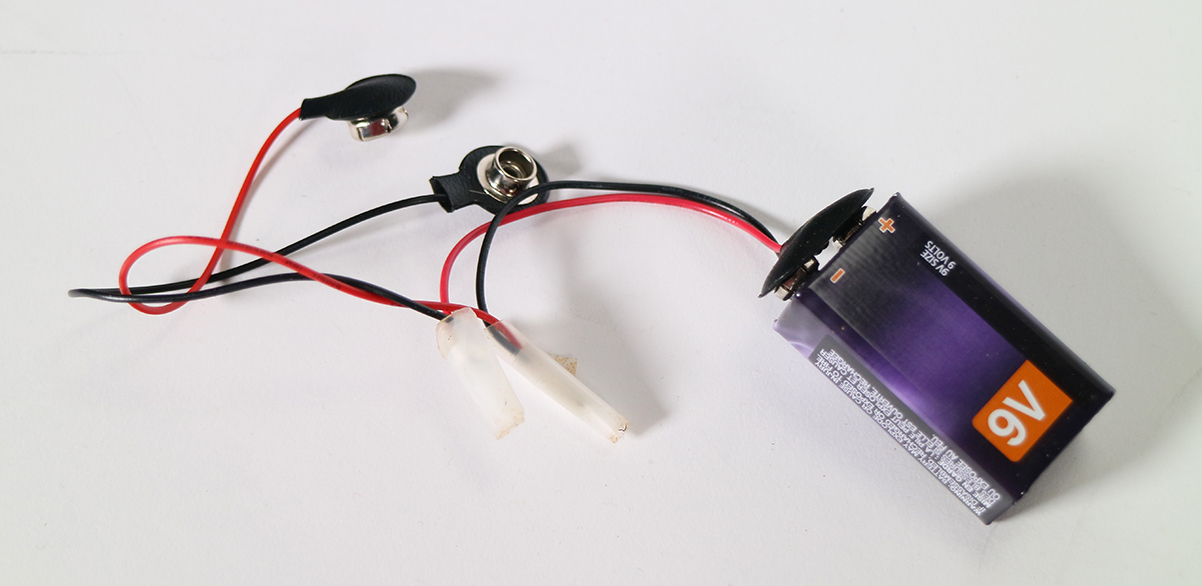
The probable advantage of the PP9 is that it would output higher current (amperage) than a smaller battery. But, the Stylophone 350S will operate on the available power from a couple of today's PP3 batteries.  I learned this by some trial and error when I got my own 350S. I wasn't able to find a pair of PP9 batteries at a reasonable cost, so I bought a couple of PP9 snap connectors and PP3 snap connectors and twisted the wires together to make two battery adapters. The large snap connectors fit over the PP9 battery connectors in the 350S, then the PP3 9 volt batteries snap to the smaller connectors.


WARNING: In my first attempt at testing these adapters, I matched the wire colors and twisted the ends together, connecting black to black and red to red. Within seconds of attaching two PP3 9 volt batteries, they started getting hot! I disconnected them right away and and twisted the wires in the opposite manner, red to black and black to red.  Then everything seemed to work just fine!  In the photo above, the wires are just twisted together. You'll need to properly solder them and cover them with electrical tape or insulated shrink tubing to prevent the wires from shorting out.

The next problem with this solution is that PP3 9 volt batteries are so small, compared to the two relatively cavernous battery compartments of the 350S, that they are going to rattle around inside the instrument and possibly cause damage by shorting out or bouncing off of nearby electrical components. So what I did was carefully move both adapters into one of the two compartments, attached the PP3 batteries, and placed the batteries inside a plastic food storage container that was about the same size as the inside of the compartment.  It was kind of a weird way to fix the problem, but this prevented the batteries from moving freely and causing mayhem, although they still moved around inside the plastic container.  Pavel Frolov, the 350S player in the Russian band Gromyka told me that he solved this problem by cutting a couple of chunks of white polystyrene foam to just the right size and shape to hold each PP3 battery securely.

Recently, the topic of 350S batteries came up in a Facebook discussion.  It inspired me to find a more proper solution that was more similar to using the original PP3 batteries. I found some nifty AA battery holders designed to replace PP7 batteries (another large member of the PP battery family.)


These battery holders fit 6 AA cells and are pre-wired with the snap connectors that will fit the PP9 connectors inside the 350S.  At about $17 USD each, they are not cheap, but they don't require any soldering and they work perfectly for the job. To save some money, you can buy the AA battery holders and the PP9 connectors separately and solder them together yourself.


They still fit rather loosely inside the 350S battery compartments, though. I happened to have some studio acoustic foam handy, so I cut a couple of pieces a little larger than the battery compartment openings and stuffed them inside. The PP9 connector sits under the foam, with the two wires coming around opposite sides of the foam, so there's no chance of any bare metal touching anything it shouldn't.  It all fits snuggly, but still allows the compartment covers to be closed properly, with nothing to rattle around inside the instrument.


As near as I can tell, the performance of the 350S seems to be identical with either of these two replacement battery solutions, but I'm not an electrical engineer, so do your own research and use your best judgement.  Above all, though, power up and play that thing!

(Note: some of the links in this blog post go to eBay. If you follow the links and make purchases, Stylophone Museum will earn a tiny commission. Pay attention to shipping costs. Depending on where you live, some items that may seem like bargains may turn out to be rather costly if being shipped internationally.)


Sunday, April 29, 2018

The Delightful (and peculiar) Stylophone 350S

I took a rather long break from posting to the Stylophone Museum. I've been in the process of selling one home and moving to another. A lot of my musical instruments got put away in cardboard boxes. Now I'm back with possibly my favorite Stylophone, the somewhat rare model 350S.


Dubreq released this instrument around 1977 and it seems their intention was to promote the 350S as a more legitimate musical instrument that could be used in a band. Some other websites and blogs claim that only a few thousand of these instruments were ever sold. (By the way, I try my best to share mostly my own opinion and direct knowledge about Stylophones, rather than just repeating information from other websites. There are lots of great resources about Stylophones on the web. You should check them out for yourself.)


The first thing you will notice about the 350S is its size. With dimensions of about 12.5"x3.5"x11.5" it dwarfs every other previous Stylophone. It's that big for a few reasons. It features 44 keys. That's almost 4 octaves or half the range of a piano. It also has two styli (more on that later.) And it sports a bigger internal speaker than the standard models. I really like the wider range of notes.  It comes in handy when playing melodies that span several octaves.


The 350S has a fairly wide range of possible timbres, too. A set of six 3-way toggle switches allow you to dial up 80 possible timbres using an additive synthesis scheme somewhat similar to a Hammond tonewheel organ. You can choose various combinations of woodwind, brass and string sounds at 16', 8', 4' or 2'. (This numbering system corresponds with the pipe lengths of a pipe organ. 8' is kind of the fundamental tone. 16' is a subharmonic an octave lower. 4' and 2' are harmonics one and two octaves higher.) Playing multiple harmonics at the same time produce a richer, more complex timbre. The woodwind sound is available in all four lengths. The brass is available in 16' and 8'. The strings sound is available at 4' and 2'. You can select 1 to 4 of these voices that play solo or in unison as one registration. Unlike a Hammond, though, you can't adjust the volume balance between the different harmonics. Warning! If all four toggle switches are in the center position, you get no sound.  I've panicked more than once when the switches were set this way and I couldn't coax out a sound.


The designations of "woodwind," "brass" and "strings" are very approximate, much like the registration names of different pipe organ sounds. I haven't hooked my 350S to an oscilloscope to see exactly what the waveforms are, but generally a square wave would be considered a woodwind sound, a sawtooth wave would be a brass sound, and a triangle wave would be a string sound. So I think that is what is going on here.

I sometimes joke that the 350S has 80 possible sounds that all sound alike.  That's not quite true, but the differences between sound combinations are fairly subtle. Fortunately, you can further manipulate those 80 sounds with 0 to 80 combinations of effects settings for a total of  6,480 possible patches (80 timbres x 80 effects + 80 timbres with no effects.)

Effects include fast and slow vibrato, fast and slow reiteration, long and short decay, and the option to use a photo control device to manipulate overall volume, vibrato volume, or a "waa waa" filter by moving your left hand above the instrument, allowing more or less light to hit the sensor. If you're playing in a room with either low light or on stage with disco balls and sweeping spotlights, the photo control isn't very practical. So, you can plug in an expression pedal and operate the same controls with your foot. To get the full range with a foot pedal, though, it is best to cover the photo sensor with something opaque, because the expression pedal adds to the photo sensor value, rather than completely replacing its function.


The vibrato effect probably needs no explanation, so I will skip it. The decay effect approximates the volume envelope of a struck or plucked instrument. A played note will fade to silence even if you are still holding the stylus against the keyboard.

The reiteration effect takes some explaining. Reiteration is a percussion effect that appeared on some electric organs in the 1960s and 70s. It also appeared in the settings of some theater pipe organs that could play actual percussion instruments in addition to the pipes. Basically, when you held down a key or keys, the organ would rapidly turn the sound on and off as if you were rapidly playing the same key(s) over and over again. (In theater organs, it would make the mallets actually strike the percussion instruments over and over again.) In electric organs, it's an effect used to imitate instruments like banjo strums and xylophones. Pete Townshend used a very similar effect on a Lowrey organ for The Who's hit song "Baba O'Riley." The Stylophone 350S employees reiteration with the left-most stylus. While in reiteration mode, you can hold the left stylus on any key to get that effect. If you continue to use the right-most stylus to play a melody, the reiteration sound will mute as long as both styli are in contact with the keyboard, and you will only hear the normal sound of the right stylus. By rapidly alternating between styli, it almost sounds as if you can play a lead line and a backing strumming sound at the same time.


On the side panel where you can plug in an expression pedal, there are also audio input and output jacks. The input jack allows another electric instrument's audio signal to be mixed with the 350S audio output. The output jack allows you to turn off the internal speaker and send to sound output to an external amplifier or recording device. There's also a tuning wheel so that you can fine-tune the 350s and match other instruments in a band.


Finally, I want to tell you about the batteries. The Stylophone 350S is designed to be powered by two PP9 batteries, which are huge 9-volt batteries that are rarely available anymore in the United States.


 Since these batteries are hard to find and rather expensive, I power my instrument with PP3 batteries, which are the more familiar, small 9-volt batteries that you used to get for free with your battery club card at Radio Shack. The space between the terminals is different between PP3 and PP9 batteries, so I had to rig and adapter for each of them. I bought some battery terminal plugs of each kind, and connected them together. With my first attempt, I got the polarity wrong and within a few seconds the batteries got very hot. Fortunately, I didn't fry the instrument. After swapping the wires, the instrument powered right up and worked just fine.


The next problem with substituting batteries is that the two battery compartments on the underside of the instrument were designed to accommodate those gigantic PP9 batteries. My little PP3 batteries would flop around loose inside the instrument and possibly do damage to the circuit board. I tried to hold the batteries in place with ordinary cellophane tape.  That worked for awhile, but the tape broke easily. For a long time, I just allowed the batteries to be loose inside there and hoped nothing bad would happen. Today, I got an idea that seems to work. I placed the two batteries inside a plastic food container that was about the right size to fit in one of the battery compartments. The batteries are trapped inside the container and the container is trapped inside the battery compartment. I'll go with this scheme until I can think of something better.


I picked up my 350S, used, from an eBay seller in the UK a few years ago.  I can't recall the exact cost, but I think it was somewhere around $150 including shipping. The box was in bad shape and the 350S had some minor cosmetic issues, but sounded great. I've seen eBay listings for allegedly NOS (new old stock) for about $220 and up. One problem with buying these instruments sight-unseen is that the seller often does not have the PP9 batteries and cannot test their 350S to verify that it still works.

If you want to hear the 350S in its full glory, check out the really cool Russian rock band called Gromyka. They used the 350S as their primary keyboard instrument.


If you are a Stylophone fan and you can get one, I highly recommend this instrument. I really enjoy playing the 350S. It has many of the quirky charms of the original Stylophone, but it is a richer-sounding instrument that is a giant leap closer to the sound and functionality of an electric organ. Keep in mind, though, that any electronic device this old can fail at any moment. Repairing one can be either costly or impossible. Every time I play my 350S, I think about this and appreciate it even more.


Tuesday, November 28, 2017

Russian band features the Stylophone 350s

I just found out about an interesting Russian rock band called Gromyka. They use a vintage Stylophone 350s as their main keyboard instrument. Cool, huh?!


In the YouTube video below, the Stylophone player is using the second stylus to engage the 350s reiterate function, which is sort of an extreme tremolo or strumming/percussion effect. If you use the regular stylus in your left hand and the reiterate stylus in your right hand, as the guy in the video is doing, you can play two pitches simultaneously, with the lower pitch constant and the higher pitch reiterating.


Similar reiterate effects were found on some 1960s and 1970s electric organs, such as the Hammond E-100 series tone wheel organs.

The 350s is somewhat rare but used instruments can still be picked up on eBay for around $200 to $300. It requires two of an obsolete type of 9 volt battery, but it can be modified to use other types of batteries fairly easily. It is a blast to play and has some nice features that were intended to make it appeal to serious musicians. My 350s is my favorite Stylophone to play when jamming with other musicians. I will share some photos in a future post.