Showing posts with label vintage. Show all posts

Thursday, August 30, 2018

A little higher and a little lower: The Treble and Bass Stylophones

The modern Stylophone S1 instruments have been made available in several different color schemes, but they all have the same features and sounds. That wasn't the case with some earlier Stylophone models in alternative color schemes. While the commonly available black-and-white Stylophone from the 1960s was the standard model, instruments with white and beige-and-white cabinets were also sold.


The white "treble" model substitutes a few electronic component values in the circuit, so that the instrument's pitch range is an octave higher. The beige-and-white "bass" model has pitch range an octave lower than the standard instrument.


If you would like to add these two rarities to your own Stylophone collection, try the UK version of eBay. It is not unusual to see treble Stylophones listed there, priced around the equivalent of  $15 to $30 USD. I've seen several treble Stylophones listed on the US version of eBay as well.

The bass model seems to be quite rare, so it may take some patience and luck to find one. I had an automatic search set up on eBay for a couple of years before I was able to buy one from a seller in France. As I recall, the purchase price was around $15 USD, but the shipping cost was around $30. When the instrument arrived, I fired it up and it worked for only about 30-seconds. I took it to a local amplifier and keyboard repair shop, along with a copy of the circuit schematic I found online. They were able to replace a few failed components on the circuit board and have it sounding almost good-as-new. The repair job cost me around $70, but should have cost more. The technician gave me a discount because he found the project amusing. So, my $15 bass Stylophone was not such a bargain after all.

I find the treble version of the Stylophone to work and sound as expected. The bass model doesn't seem to be quite in-tune in the lower few notes. I don't know if this is due to the original design, the age of the instrument, or the repair job.

The bass and treble Stylophones are certainly not essential for any musical application. A standard model can be pitched up or down with a computer DAW or an effects pedal for very similar results, but I find it fun to have these peculiar variants in my already peculiar collection of vintage Stylophones.

Friday, December 15, 2017

Stylophones get amped up!

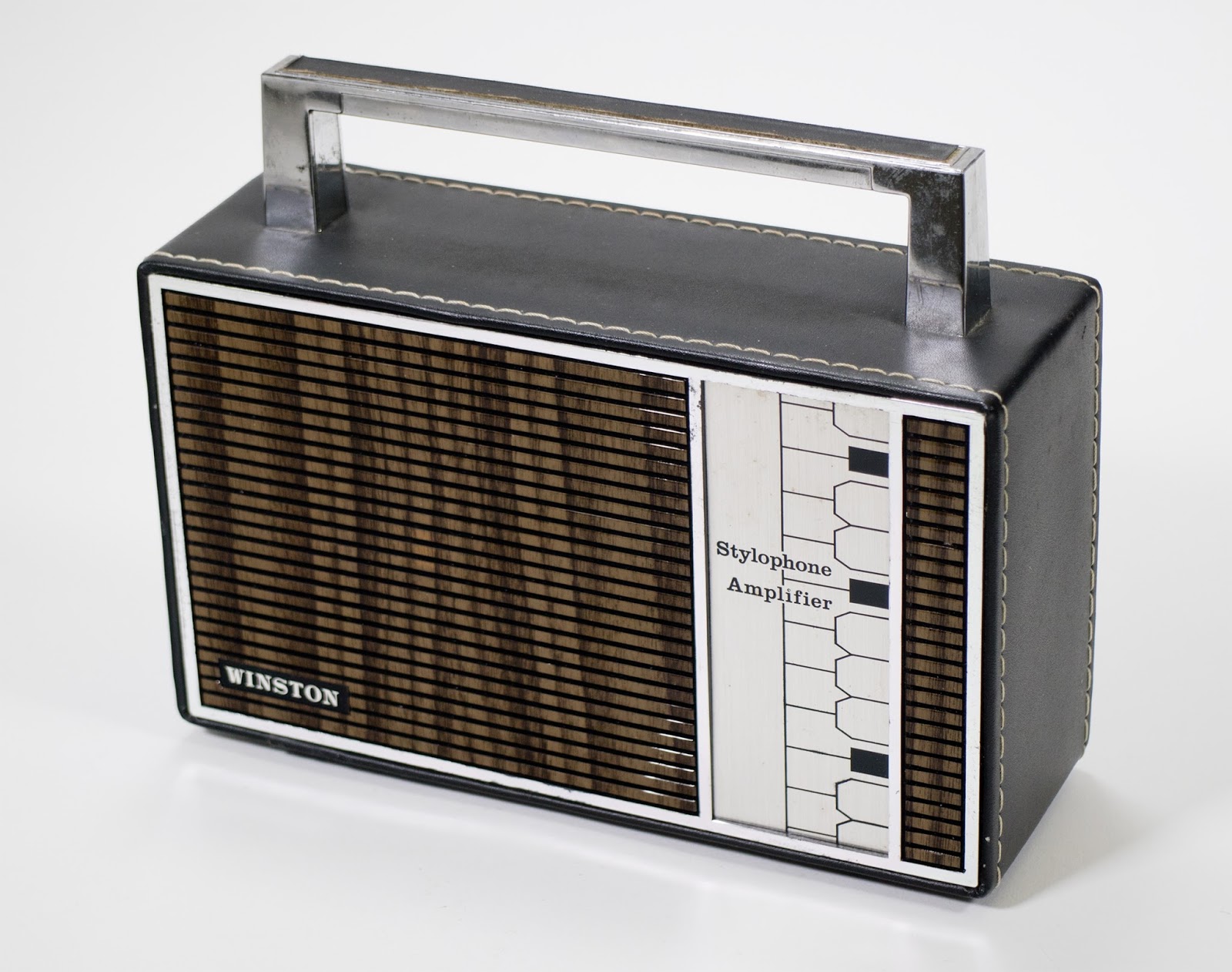
The Stylophone Museum has three vintage Stylophone mini amplifiers. They were all made in Hong Kong under the Winston brand name and sold for around $10 each when new.


All three amps are identical in size at 8.25" wide by 4.75" high by 2.5" deep, but vary quite a bit in overall design and functionality.  They aren't marked with model names or numbers, so I will call them Amp A, B & C.

Amp A is the one that seems to be the most common. It was advertised as a mail-order accessory in the documentation for Stylophones sold by the American Stylophone Company in Chicago, Illinois. The price was $9.95 plus $1 for shipping and handling, plus 50 cents sales tax for Illinois residents.


It features the familiar vintage Stylophone keyboard design on the front panel and a plastic speaker grille with a simulated wood grain pattern. It operates on nine C batteries. There are no audio input jacks because the back panel conceals a dual-plug cable.  The eighth-inch plug connects to an instrument's amplifier output jack. The smaller plug connects to certain instruments that also had an external battery input jack. On my unit, this power cable doesn't work properly with my dual-jack Stylophone pictured above, so I have to leave it unplugged.

Amp A does offer richer sound quality than a built-in Stylophone speaker, but it is not significantly louder.  It lacks volume and tone controls, so the sound you get can't be adjusted. There isn't a power switch either, so you need to unplug the audio cable from the Stylophone when not in use.


Amp B does not have any dubreq or Stylophone logos or markings, so I am not absolutely certain that it was originally marketed as a Stylophone accessory. It features an Off/On/Volume knob, which is a handy feature, considering that the earliest several Stylophone models lacked any sort of volume control.  There is also a tone control that can be used to adjust the brightness of the sound. This amp runs on four D batteries and has an eighth-inch audio input jack on a side panel.  Curiously, this amp's output is really no louder or better than a built-in Stylophone speaker, but with the volume control, it can be quieter. Sometimes a quieter Stylophone is a good thing.


Finally, I have Amp C. Unfortunately, this one does not work. I've never seen another specimen like it. The cabinet design is nearly identical to my Amp A, including the Stylophone keyboard graphic, but the audio input jack is a quarter-inch phone jack located on the lower front panel. There are no control switches, buttons or knobs and it is designed to operate with two C batteries. There are very few electronic components in the point-to-point wiring.

(A reader has suggested that Amp C could be an Amp A unit that someone has customized with new circuitry for use as a guitar amp. It seems plausible.)


All three of these amplifiers are amusing additions to the Stylophone Museum, but have no practical value to the modern Stylophone player. You are far better off plugging your vintage Stylophone into almost any modern amplifier or portable MP3 speaker for better and louder sound.